
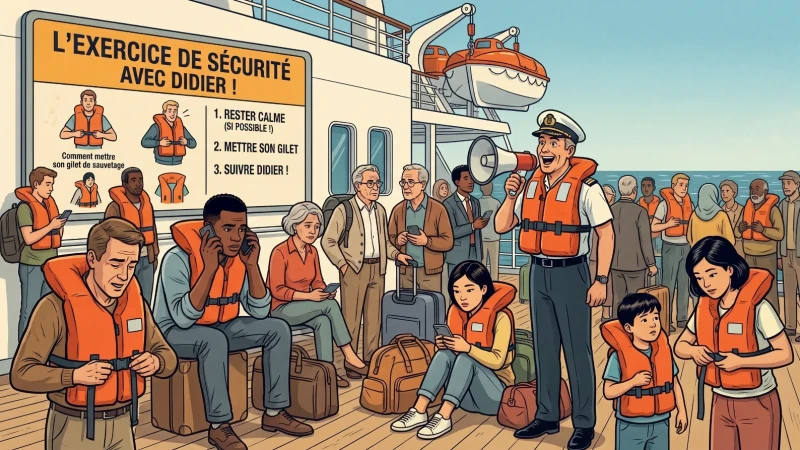
A chronicle of the longest half-hour of your holiday
You have just boarded. Your cabin is gorgeous, the buffet is giving you the eye, your first welcome cocktail is going warm in your hand, and the ship hasn't even left the quay. The holiday has begun.
And then, through every loudspeaker on the ship, a calm voice announces in six languages that the safety drill is about to start. Nobody gets out of it. Not even you. Not even Derek.
Welcome to every cruiser's first rite of passage.
The idea (on paper)
It is compulsory, and it is serious: before the ship puts to sea (or very shortly after departure), every passenger must know where their muster station is, how to put on a life jacket and what the alarm signal sounds like. It is the international rule for safety at sea and, frankly, it is a good rule.
On paper it is simple: your muster station is shown on your cruise card and on the back of your cabin door. You go there, someone ticks you off a list, someone explains the procedure. Fifteen minutes, job done.
On paper.
On paper it is simple: your muster station is shown on your cruise card and on the back of your cabin door. You go there, someone ticks you off a list, someone explains the procedure. Fifteen minutes, job done.
On paper.
Version 1: the old-school drill
On some ships the drill is still done the old-fashioned way. You have to take the life jacket out of your wardrobe. The orange one. The big one. The one that smells of new plastic and your nan's airing cupboard.
You put it on. You don't know which way round. You turn it over. Still wrong. Your other half watches you wrestle with the straps like a cat in a duvet cover. You end up looking like a traffic cone with legs.
Then you step out into the corridor. And there you discover that 2,000 other people, also dressed as traffic cones, are looking for the same staircase as you. An orange tide flows down the decks with a gentle rustle of plastic. It is beautiful, in its way. Mostly, it is very slow.
Version 2: the digital drill
The good news: many cruise lines have switched to a modern version. You watch a safety video on the ship's app or on your cabin TV, then pop along to your muster station to have your card scanned. No life jacket to put on, no packed crowd.
The bad news: the video lasts several minutes, you can't fast-forward it, and the app refuses to let you move on until you have watched it to the very end. You start it on your phone thinking you'll do something else at the same time. The app knows. The app is judging you.
The bad news: the video lasts several minutes, you can't fast-forward it, and the app refuses to let you move on until you have watched it to the very end. You start it on your phone thinking you'll do something else at the same time. The app knows. The app is judging you.
The muster station: a place of mystery
Your muster station has a code name. "C". "Muster Station 7". Or, more poetically, "Theatre Aurea, deck 6, starboard side".
The problem is that you have been on board for 52 minutes and you still don't know which end of the ship is the front. You know where the buffet is. That's it. (If that sounds familiar, our survival guide to finding your way around on board is for you.)
Fortunately, crew members are posted at every junction, with signs and infinite patience. They show you the way. With a smile. For the 340th time that day.
The species you will meet
Maureen and Barry from Solihull: arrived at the muster station 25 minutes before the announcement. Front row. Life jackets perfectly fitted, straps tightened, whistle at the ready. Barry has even read the instructions. They have done the drill on 23 cruises and never miss a word of it. Maureen gives you a little wave: "Are you in station C as well? Oh, lovely!"
The Latecomer: he arrives at a run, in a bathrobe, still dripping from the pool, life jacket under his arm. He didn't know. Nobody told him. (Everybody told him. Three times. In six languages.)
The Photographer: takes a selfie in his orange life jacket for his Instagram story. Caption: "Iceberg, right ahead! 😂🚢". The crew member in front of him does not laugh.
The Objector: "Honestly, what's the point? It's not the Titanic." He sighs loudly throughout the session. He is the first to ask where the lifeboats are when the ship rolls a little on the third evening.
Derek: Derek is lost. Derek is at the wrong station. Derek is at station D, port side, when he should be at station C, starboard side, at the other end of the ship. Derek followed the crowd. Derek followed the wrong crowd. When the crew member scans his card, the machine gives a disapproving beep. Derek sets off again, life jacket askew, socks-and-sandals slapping on the deck, in search of his station. We see him again at the end of the drill, out of breath, arriving just as everyone else is leaving.
The session itself
Once everyone is assembled (well, almost everyone: Derek is still on his way), an officer speaks. He explains, very calmly, what to do in an emergency.
You learn that the general alarm signal is seven short blasts followed by one long blast, on the ship's whistle and the alarm bells. You listen carefully. You make a mental note. You will have forgotten it in 40 minutes, somewhere between the second cocktail and the welcome show.
You are shown how to adjust your life jacket, where the whistle is, what the little light is for. Everyone nods gravely. A child in the front row blows his whistle. Then a second child. Then all the children. The officer waits patiently for the brass band to settle down.
The 30 minutes on your feet
On some ships you then have to wait until everyone has been accounted for before you can leave. Everyone. Derek included.
So you wait. Standing. In the sun. In an orange life jacket. You sweat. You look at your watch. You look at the bar on deck 14, just above you, hopelessly closed during the drill. You think of your welcome cocktail, which must by now have reached room temperature for good.
When the officer finally announces the end of the drill, a discreet cheer ripples through the crowd. You have survived. You are officially a cruiser.
What you will never say out loud
That night, drifting off in your cabin, rocked by the swell, you think back to the drill. To the officer's calm voice. To the crew members posted everywhere. To the life jacket in your wardrobe, which you now know exactly how to put on.
And you tell yourself that, all things considered, it is rather reassuring to know that thousands of people on board know where their muster station is. Even Derek. (Well, almost.)
And you tell yourself that, all things considered, it is rather reassuring to know that thousands of people on board know where their muster station is. Even Derek. (Well, almost.)
Our tips to make it go smoothly
- 🗺️ Find your muster station as soon as you board: it is shown on your card and on the back of your cabin door. Wander over once, calmly, before the drill
- 📱 Watch the video as soon as you can, if your cruise line offers the digital drill: you'll have it done before the crowds
- ⏰ Don't plan anything during the drill: bars, pools and restaurants generally close in the meantime
- 👀 Really listen: it is not a formality, it is your safety. And your children's
- 🧓 Reduced mobility? Tell guest services as soon as you board: the crew can arrange specific assistance (see our article on accessibility on cruises)
- 🍹 Save your welcome cocktail for afterwards. It tastes better cold
The final word
The safety drill is the only half-hour of the cruise when 4,000 people from twenty different countries do exactly the same thing, at the same moment, in the same ridiculous life jacket. It is a bit long, a bit hot, a bit absurd.
But it is also the first time you meet the people who will share your week at sea: Maureen and Barry, the Photographer, the Objector… and Derek, who will find his station eventually. Before the end of the cruise. Probably.
Smooth sailing, and see you later at the muster station. 🦺
But it is also the first time you meet the people who will share your week at sea: Maureen and Barry, the Photographer, the Objector… and Derek, who will find his station eventually. Before the end of the cruise. Probably.
Smooth sailing, and see you later at the muster station. 🦺