Transatlantic Cruises

About transatlantic cruises

🌊 Transatlantic cruise: the great crossing

The transatlantic cruise carries on the tradition of the great ocean crossings. For 10 to 20 days, enjoy the unique experience of sailing across the heart of the Atlantic, like the legendary ocean liners of old. A timeless interlude between Europe and America. 🚢

📅 Transatlantic crossings at a glance

⏱️ Duration and distance

  • 📏 Distance: around 5,000-6,000 km depending on the itinerary
  • 📅 Typical duration: 7-8 days at sea + ports of call (12-18 days in total)
  • 🌊 Sea days: 5-7 consecutive days of sailing
  • ⚡ Speed: 20-25 knots (40-45 km/h)

📆 Seasons

  • 🌸 Spring (April-May): repositioning to Europe
  • 🍂 Autumn (Oct-Nov): repositioning to the Caribbean/USA
  • 💡 Tip: attractive fares because these are "repositioning" cruises

🗺️ Popular itineraries

🇪🇺 Europe → Caribbean (autumn)

  • ⚓ Departures: Barcelona, Marseille, Civitavecchia, Southampton
  • 🏝️ Possible ports of call: Canary Islands, Madeira, Azores
  • 🌴 Arrivals: Fort-de-France, Pointe-à-Pitre, Miami
  • 📅 Duration: 14-18 days

🏝️ Caribbean → Europe (spring)

  • ⚓ Departures: Miami, Fort Lauderdale, San Juan
  • 🏝️ Possible ports of call: Bermuda, Azores
  • 🇪🇺 Arrivals: Southampton, Barcelona, Marseille

🗽 Europe ↔ United States

  • 🇬🇧 Southampton ↔ 🗽 New York: the classic route
  • 🚢 Cunard Queen Mary 2: the only true scheduled transatlantic liner
  • 📅 Duration: 7-8 days (straight crossing)

🌊 The sea-day experience

Sea days are the heart of the transatlantic experience:

  • 🌅 Contemplation: the vastness of the ocean, sunrises and sunsets
  • 📚 Reading: library, deck chairs in the sun
  • 🍽️ Gastronomy: time to savour every meal
  • 🎭 Shows: a rich programme every evening
  • 🎓 Lectures: cultural enrichment
  • 💆 Spa: relaxation and treatments
  • 🏊 Pools: a swim in mid-ocean

🚢 Cruise lines and ships

🏆 Queen Mary 2 (Cunard)

  • 👑 The only true ocean liner: designed for the North Atlantic
  • 🚢 Regular crossings: Southampton ↔ New York
  • 🎩 Tradition: dress code, afternoon tea, British service
  • 💶 From: €1,200 (inside cabin, 7 nights)

🛳️ Other cruise lines

💶 Budget

  • 💰 Entry level: €600-1,000 (inside, repositioning)
  • ⭐ Standard: €1,200-2,500 (balcony)
  • 👑 Premium: €3,000-8,000+ (suite)
  • 💡 Tip: repositioning cruises are often cheaper

✨ Highlights of a transatlantic crossing

  • 🌅 Total disconnection: no reliable internet connection in mid-ocean
  • ⏰ Time changes: +1 hour every night (heading west)
  • 🐬 Marine wildlife: dolphins, whales, pelagic birds
  • 🌟 Starry skies: far from any light pollution
  • 📖 Time for yourself: reading, rest, reflection

💡 Practical tips

  • 🤢 Seasickness: the Atlantic can be rough (bring medication)
  • 🧥 Weather: changeable, bring warm clothes for the deck
  • 📱 Connectivity: limited and expensive at sea (enjoy being offline!)
  • ⏰ Jet lag: a 5-6 hour time difference to adjust to
  • 📚 Books: take several with you
  • 🎭 Dress: gala evenings with some cruise lines

🗺️ Typical ports of call

  • 🇪🇸 Canary Islands: Tenerife, Las Palmas
  • 🇵🇹 Madeira: Funchal
  • 🇵🇹 Azores: Ponta Delgada
  • 🇧🇲 Bermuda: Hamilton
  • 🗽 New York: a legendary arrival

Tourism on a transatlantic crossing

Transatlantic travel is all about a contemplative, restful approach to sea voyaging.

The classic itineraries link Southampton, Barcelona or Marseille in Europe with New York, Fort Lauderdale or Miami in North America, sometimes with calls in the Azores, Madeira, the Canary Islands or Bermuda, depending on the route chosen.

The 7-8 day Southampton-New York crossing follows the legendary route of the Titanic and the great ocean liners. Arriving in New York in front of the Statue of Liberty is an iconic moment.

Some extended itineraries include the Caribbean or head north to Iceland and Greenland.

On board, the atmosphere recalls the golden age of ocean liners:

  • Gala evenings
  • Tea dances
  • Maritime lectures
  • Classic film screenings
  • A variety of entertainment

Passengers enjoy a full range of facilities: libraries, spas, pools, gyms, theatres, casinos and many restaurants. The pace is relaxed, without the stress of daily ports of call. Cruisers particularly love the sunrises and sunsets over the endless ocean, watching dolphins and whales, and the unique feeling of sailing for several days out of sight of land.

The officers often organise bridge tours and explain ocean navigation. The cosmopolitan atmosphere encourages encounters between passengers of many nationalities who share a passion for sea travel.

Countries in this region

France

France

France holds a special place in the world of Mediterranean and river cruising, offering prestigious ports of call on: The Côte d'Azur Authentic Provence The river valleys of the Seine, the Rhône and…

Discover
Spain

Spain

Spain is one of the most popular destinations for Mediterranean cruises, combining exceptional cultural heritage, beautiful beaches and world-renowned gastronomy. From cosmopolitan Barcelona to…

Discover
Portugal

Portugal

Portugal, an ocean nation washed by the Atlantic, charms cruise passengers with its easy-going way of life and preserved authenticity. From Lisbon, perched on seven hills, to the terraced vineyards…

Discover

Transatlantic Cruises

Transatlantic cruises are concentrated in two periods each year: October-December for east-west crossings (Europe to the Americas) and March-May for the west-east return. These repositioning cruises last from 13 to 30 days depending on the itinerary and intermediate ports of call.

Fares are generally very attractive compared with classic cruises, starting at around €400-600 per week, an exceptional opportunity to sail at a gentle price. The best deals appear 3-6 months before departure or at the last minute (less than 60 days).

MSC Cruises offers 24 itineraries on 15 different ships for 2025-2026, exploring more than 80 ports in 50 countries on 4 continents.

Cunard carries on the tradition with Queen Mary 2, which regularly makes the Southampton-New York crossing and offers an experience close to the liners of old: assigned restaurants, an evening dress code and a refined British atmosphere.

Princess Cruises also serves these routes with modern ships. Costa, Royal Caribbean and Norwegian offer their own versions. Balcony cabins are recommended to make the most of the ocean.

The fare includes full board, entertainment and generally good-value drinks packages. New for 2026: a departure from Cherbourg with Cunard. US entry formalities (ESTA) are required.

These cruises attract an international clientele looking for calm, elegance and time for themselves, far from mass tourism.

Cruise lines offering transatlantic cruises

The cruise lines whose scheduled cruises call in the region, from the most to the least frequent. Language on board, service charges, prices: compare them on their individual pages.

Compare all cruise lines

Ports of call in this destination

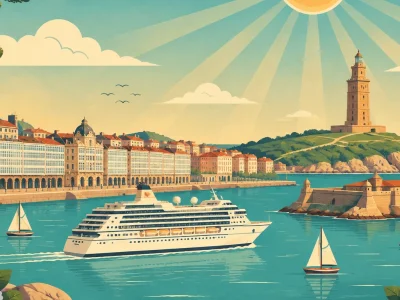
A Coruña (Spain)

A Coruña (Spain)

Galician city between the Atlantic Ocean and the Tower of Hercules

Discover
Aberdeen (United Kingdom)

Aberdeen (United Kingdom)

Aberdeen, a port on Scotland's east coast, with Old Aberdeen, Duthie Park, whisky distilleries and Dunnottar Castle.

Discover
Ajaccio (France)

Ajaccio (France)

Corsica's capital, between Napoleonic history and Mediterranean nature

Discover

Weather and climate on a transatlantic crossing

Transatlantic cruises cross the North or subtropical Atlantic, with weather conditions that vary with the season and the route taken.
Autumn - East to West (October-December): Repositioning season to the Caribbean. Early October: still mild (18-24°C) with generally calm seas. November-December: cooler temperatures in mid-ocean (12-18°C), sometimes rough seas (Atlantic depressions), strong winds possible. The calls in the Canary Islands and Madeira offer a mild, sunny climate (20-25°C). Bring warm clothes for the decks (wind), but also light ones for the subtropical ports of call and the arrival in the Caribbean (28°C).
Winter - Direct crossings (January-February): The toughest period on the North Atlantic. Often rough seas, heavy swell, cold temperatures (8-15°C at sea, icy wind on deck), risk of winter storms. These crossings are rare and best left to seasoned sailors. Queen Mary 2 keeps up some rotations all year round thanks to her hull, specially strengthened for the North Atlantic.
Spring - West to East (March-May): Return season to Europe. March: seas still unpredictable, cool temperatures (10-16°C). April-May: conditions gradually improve, calmer seas, mild temperatures (15-20°C), an excellent time to cross. Arrival in Europe at the start of the European summer. This is the best time for a first transatlantic crossing: generally kind seas, pleasant temperatures, lengthening days.
Summer (June-September): Few transatlantic crossings, as the ships are in the Mediterranean or Alaska. July-August: optimal conditions (20-25°C, calm seas) but a risk of tropical storms/hurricanes in August-September in the Caribbean and subtropical Atlantic, which may change itineraries.
Practical tips: The Atlantic is unpredictable. Bring seasickness medication (even experienced sailors can be affected in heavy swell). Modern ships have stabilisers that greatly reduce rolling. Cabins midship and on lower decks are the most stable. Several consecutive days at sea can feel long for some - make the most of them to rest, read, attend lectures and shows, and socialise.