
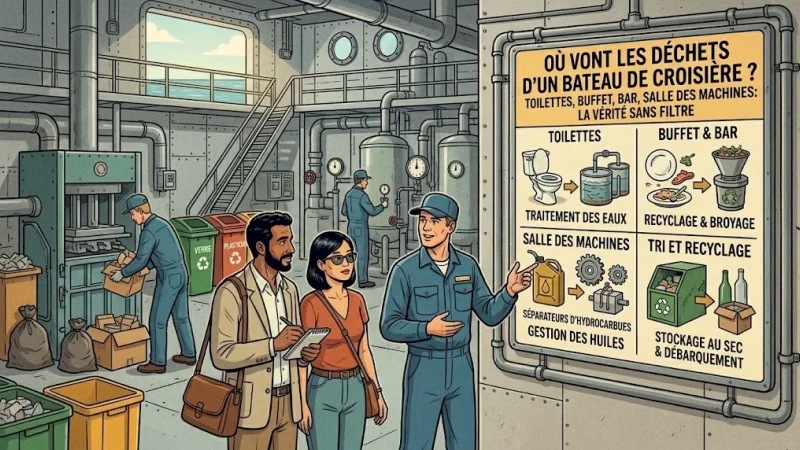
You flush the toilet in your cabin: a « WHOOSH » worthy of a jet engine, and everything vanishes. You leave half your plate at the buffet: a waiter whisks it away. You put your empty can down on the bar table: it evaporates. 🪄
On a cruise ship, waste has an amazing talent for disappearing. But it doesn't really disappear. It goes somewhere: to a treatment plant, an incinerator, a grinder… or into the sea. 🌊
So where does a cruise ship's waste REALLY go? From the toilets to the engine room, we followed the trail of your rubbish, with the real progress, the grey areas and the scandals. No filter. 🎯
⚖️ The short answer (for those in a hurry)
- 🚽 Water from toilets and showers is treated on board, then discharged into the sea. On most recent ships, through a proper treatment plant. On the others, further from the coast
- 🍽️ Food leftovers are ground up or liquefied… and they too are discharged into the sea, legally, more than 12 miles from the coast in the Mediterranean
- ♻️ Glass, cans and cardboard are sorted by hand by the crew, compacted and landed in port for recycling
- 🔥 The rest is often burned in the ship's incinerator, or landed
- 🚫 Plastic: banned from being discharged at sea, everywhere, since 2013
- ⚠️ The real problem: checks. Discharges are mostly self-reported by the cruise lines, and a few resounding scandals have shown that trust has its limits
📦 How much waste on a cruise ship?
A cruise ship with 5,000 passengers is a town of 7,000 people once you add the crew. A town that eats a lot (we cover this in our chronicle on the all-you-can-eat buffet challenge), showers every day and drinks a lot of cocktails.
The reference figures come from a major study by the US Environmental Protection Agency (EPA) in 2008. Recent ships use less water, so treat them as orders of magnitude:
The reference figures come from a major study by the US Environmental Protection Agency (EPA) in 2008. Recent ships use less water, so treat them as orders of magnitude:
- 🚽 Black water (toilets): about 30 litres per person per day. Thanks to vacuum toilets (the famous « WHOOSH »), a flush uses about 1 litre, compared with 5 at home
- 🚿 Grey water (showers, washbasins, galleys, laundry): about 250 litres per person per day
- 🗑️ Solid waste: about 1 to 2 kg per person per day, plus two bottles and two cans
Which gives, for one week on a large cruise ship (our calculation, based on these averages):
| Waste | For one week (7,000 people) | To picture it |
|---|---|---|
| Black water | ~1,500 m³ | more than half an Olympic swimming pool |
| Grey water | ~12,000 m³ | nearly 5 Olympic swimming pools |
| Solid waste | ~50 to 100 tonnes | 5 to 10 full bin lorries |
| Cans and bottles | ~70,000 | a local pub over several years |
🚽 Toilets and showers: where does the waste water go?
💧 The ship's treatment plant
Most large recent ships carry an advanced wastewater treatment system (AWTS): filtration, biological treatment, membranes, ultraviolet disinfection. According to the Cruise Lines International Association (CLIA), 84% of its members' ships were equipped with one in 2025 (249 ships, compared with 136 in 2018). On MSC World Europa, for example, the cruise line claims the discharged water is « close to tap water quality ».
The treated water is then discharged into the sea. The sludge left at the bottom of the tanks is dried, then incinerated on board or landed in port.
📏 What the rules say
The global rules come from the international MARPOL convention:
The global rules come from the international MARPOL convention:
- ✅ Water from an approved treatment plant can be discharged anywhere
- ⚠️ Water that has simply been ground up and disinfected: more than 3 nautical miles from the coast (about 5.5 km)
- ⚠️ Untreated water: more than 12 miles out (about 22 km), with the ship under way at 4 knots or more
- 🇪🇺 Baltic Sea: since 2023, any discharge of untreated sewage by a passenger ship is banned
- 🌊 Mediterranean: no special rule for sewage, the general rules apply
🤔 The catch
The NGO Friends of the Earth, which grades the cruise lines every year, has refused since 2020 to give its top mark to a ship simply because it has a treatment plant: no cruise line publishes its actual results. And in Alaska, one of the few places where discharged water is tested, limit breaches have tripled since onboard inspectors were withdrawn in 2019, to 60 to 75 a year.
🍽️ Galley and buffet: the great journey of leftovers
🥩 The leftovers on your plate
What you leave on your plate will never be served to anyone else: for hygiene reasons, a dish that has already been put out at the buffet cannot be given away. It takes one of three routes:
What you leave on your plate will never be served to anyone else: for hygiene reasons, a dish that has already been put out at the buffet cannot be given away. It takes one of three routes:
- 🌀 The grinder: leftovers are reduced to pieces smaller than 25 mm, then discharged into the sea. This is allowed more than 3 miles from the coast in normal waters, and more than 12 miles out in protected areas such as the Mediterranean, the Baltic or the Caribbean
- 🧪 The biodigester: a machine that liquefies leftovers using bacteria. The Carnival group (Costa, AIDA, Princess…) has more than 640 of them across its fleet. The resulting liquid is… discharged into the sea as well, under the same rules
- 🔥 The dehydrator: it removes the water and reduces the volume by about 90%. The dry residue is burned or landed
💡 In other words: on a cruise, your buffet leftovers most often end up as fish food, out at sea. It's legal, and it's less harmful than plastic. But it isn't « zero impact » either: these discharges add nutrients that can disrupt the marine environment.
📉 Food waste is falling (really)
This is one of the good-news parts of this feature, because waste costs the cruise lines money:
This is one of the good-news parts of this feature, because waste costs the cruise lines money:
- 📊 Carnival reports 47% less food waste since 2019, and is aiming for 50% by 2030
- 📊 Royal Caribbean reports about 25% less than in 2019, well short of its 50% target for 2025
- ⚖️ Costa has been weighing its galley bins since 2017 with a smart system (Winnow) that identifies what is thrown away and adjusts production
- ❓ MSC does not publish a comparable figure, as far as we know
🤝 Dishes that were never served, on the other hand, can be donated
Since 2017, Costa has been donating dishes that were prepared but never put out at the buffet to charities, starting with the Italian Food Bank in Savona. Portions are packed in trays, labelled and chilled on board, then handed over on the quay. The programme now covers some twenty ports, including France, Martinique and Guadeloupe, with more than 320,000 portions donated.
🍹 The bar: cans, bottles and straws
At the bar, this is the most virtuous part of the circuit:
- 🍾 Glass is crushed on board and sorted by colour (green, brown, clear). A single ship can produce several tonnes a week
- 🥫 Cans are compacted, cardboard is baled
- 📦 Everything is stored in the holds and then landed in port for recycling
- 🥤 Plastic straws have disappeared from most fleets since 2018-2019 (Royal Caribbean, MSC…), replaced by paper straws or served only on request
💡 Some cruise lines even turn it into good deeds: Ponant gives its cans and bottle caps to a foundation for children's hospitals in Argentina. You may have read that the recycling money pays for crew leisure activities: it's a nice story, but we found no evidence of it.
To drink fewer cans, there is also… your choice of drinks package and a reusable water bottle.
🗑️ Your cabin bin
You don't sort anything in your cabin? That's normal: the crew does the sorting, by hand, in dedicated rooms deep inside the ship. On MSC World Europa, waste is split into 7 streams, each compacted or crushed.
- 🔥 Whatever can't be recycled is often burned in the ship's incinerator. The ash is analysed, then landed or discharged into the sea if it contains no plastic residue
- ☣️ Hazardous waste (batteries, fluorescent tubes, dry-cleaning chemicals, paints, out-of-date medicines) is stored separately and handed over to specialist facilities ashore
- 🚫 Plastic must never end up in the sea, anywhere in the world, since 2013
⚙️ The engine room: oils, bilge water and scrubbers
🛢️ Bilge water and oils
At the bottom of the engine room, water mixed with oil, fuel and cleaning products builds up: this is bilge water. To discharge it, it has to go through a separator until it contains less than 15 parts of oil per million, monitored by an alarm that stops the discharge if the limit is exceeded. Every operation is recorded in an official log. Used oils and residues are burned on board or landed.
The benchmark scandal: in 2016, Princess Cruises was fined 40 million dollars in the United States, a record penalty, for having discharged oily water for years through a « magic pipe » that bypassed the separator on Caribbean Princess. It was a young engineer who blew the whistle. In 2019, Carnival and Princess paid 20 million more for violating their probation, notably by mixing plastic into food waste discharged in the Bahamas and by preparing ships ahead of audits. Since then, we have found no new conviction of this kind against a cruise line.
💨 Scrubbers: air pollution… shifted into the water
To meet sulphur limits without switching to a more expensive fuel, many ships use scrubbers (exhaust gas cleaners): the exhaust fumes are washed with seawater. In the « open-loop » version, this washwater, loaded with metals and hydrocarbons, is discharged straight into the sea. According to a 2021 study, cruise ships account for about 15% of these discharges worldwide, but for most of them in the worst-affected ports.
To meet sulphur limits without switching to a more expensive fuel, many ships use scrubbers (exhaust gas cleaners): the exhaust fumes are washed with seawater. In the « open-loop » version, this washwater, loaded with metals and hydrocarbons, is discharged straight into the sea. According to a 2021 study, cruise ships account for about 15% of these discharges worldwide, but for most of them in the worst-affected ports.
- 🇫🇷 France: discharges banned in ports and within 3 miles of the coast since 1 January 2022
- 🇩🇰🇸🇪🇫🇮 Denmark, Sweden, Finland: banned in their territorial waters since July 2025
- ⚓ Many ports: Lisbon, Valencia, Algeciras, Amsterdam, the Norwegian fjords…
- 🇺🇸 Alaska: in 2026, the State is criticising the Carnival group for refusing to hand over its scrubber discharge data
💡 LNG-powered ships don't need scrubbers: that's one of their real advantages (we cover this in our article Cruises and the environment).
🔧 Spare parts and scrap metal
Filters, worn parts, scrap metal, gases from the refrigeration systems: they are landed in port and handed over to recycling or treatment facilities, as for any other ship.
Filters, worn parts, scrap metal, gases from the refrigeration systems: they are landed in port and handed over to recycling or treatment facilities, as for any other ship.
⚓ In port: the big unloading
In Europe, a 2019 directive requires ships to deliver their waste at every port of call, unless they have enough storage space to keep it until the next one. And to remove the temptation to dump everything at sea, they pay a flat fee, whether they deliver their waste or not.
According to a European Commission report from September 2026, ports are receiving more and more waste from ships, which is a good sign. But eight countries failed to reach the minimum ship inspection rate in 2025, and the European Court of Auditors has pointed to checks that are often inadequate. A 2024 European directive also extends penalties to illegal discharges of sewage, garbage and scrubber washwater.
According to a European Commission report from September 2026, ports are receiving more and more waste from ships, which is a good sign. But eight countries failed to reach the minimum ship inspection rate in 2025, and the European Court of Auditors has pointed to checks that are often inadequate. A 2024 European directive also extends penalties to illegal discharges of sewage, garbage and scrubber washwater.
✅ What's improving / ❌ what's still stuck
✅ The real progress
- 💧 A modern treatment plant on more than 8 ships out of 10
- 📉 Food waste down sharply at Carnival and Costa
- ♻️ Thorough sorting on board, and rising recycling rates (Royal Caribbean reports 87% of waste diverted from landfill in 2023)
- 🥤 Less single-use plastic
- ⚓ More waste landed in European ports
❌ What's still stuck
- 🔍 The lack of transparency: most figures come from the cruise lines themselves, and the actual results of the treatment plants are not published
- 🌊 Food leftovers, ground up or liquefied, still end up in the sea
- 💨 Open-loop scrubbers, which shift pollution from the air into the water
- 👮 Checks, inadequate in Europe as in Alaska
💡 What you can do on board
- 🍽️ At the buffet, take small portions and go back if you're still hungry: every half-full plate ends up in the grinder (our buffet guide has more tips)
- 🚰 Bring a water bottle and fill it at the fountains
- 🧴 Choose solid toiletries and the bathroom dispensers over mini bottles
- 🛏️ Keep your towels and sheets for several days: less laundry, less grey water
- 🛍️ In port, avoid disposable packaging: you bring it back on board, and the ship has to deal with it
- 🔎 Before booking, look at the cruise line's commitments: treatment plant, shore power connection, LNG propulsion or closed-loop scrubbers. And don't hesitate to ask for its food waste figures: the question will end up counting
💬 In a nutshell
No, a cruise ship no longer throws everything overboard as people sometimes imagine: plastic is banned at sea, glass and cans are recycled, and most ships treat their waste water.
But the sea remains the final destination for a good share of the waste: toilet water after treatment, ground-up buffet leftovers and, on some ships, the washwater from the exhaust fumes. All of it is legal, but still too rarely checked, and past scandals have shown that the law is not always enough.
The good news is that things are moving, and part of the solution is on your plate: the cleanest cruise is the one where you take just what you're going to eat. 🌍