
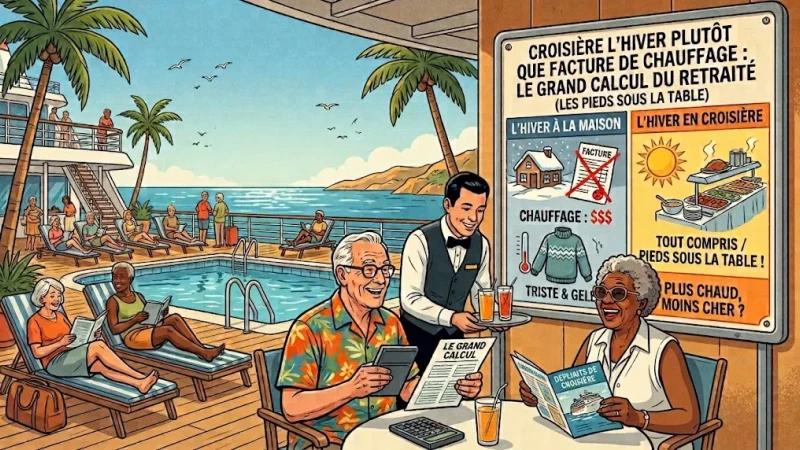
January. It's 4 °C outside, 19 °C in the living room (officially), and the boiler purrs like a cat that costs €0.1456 per kilowatt-hour. 🐈🔥
At the family lunch, the brother-in-law puts down his fork and announces: "I'm telling you, with what heating and food cost these days, you might as well go on a cruise all winter!" Everyone laughs. Then there's a little silence. And someone asks: "… No, but seriously, how would that work out?" 🤔
We took the question seriously. Energy bills, groceries, bread, petrol for the supermarket run, even the coffee at the bar: we counted everything, for a pensioner on their own and for a couple, using the real prices of this winter's cruises. Get the calculator out (and a blanket, just in case). 🧮
⚖️ The short answer (for those in a hurry)
- 🔥 Heating saved during 12 days away in January: €40 to €80 for an ordinary house. Your boiler won't pay for your cruise, sorry
- 🛒 Add in groceries, bread, petrol and small everyday spending, and you save about €340 as a couple and €230 solo
- 🛳️ On the other side, an 11-night cruise in January from Marseille costs €599 per person. With the compulsory service charges, that comes to €720 per person
- ❄️ Good news: winter is low season. Mediterranean cruises are about 25% cheaper than in summer
- 💶 The real extra cost compared with staying at home: about €550 per person for 12 days as a couple, or €46 a day, and about €76 a day solo. With the train, drinks, ports of call and insurance, allow more like €76 as a couple and €107 solo
- 🧮 Your figures are different? Use our simulator: enter your spending and it suggests real Mediterranean cruises this winter
- 🍽️ But for that price, you get the room, three meals served, the housekeeping, a show every evening and 8 ports of call in 4 countries. On land, a holiday with the same comfort would cost more than twice as much
💡 The takeaway: staying at home in winter isn't free, and a January cruise isn't that expensive. Your boiler won't pay for the trip, but the fridge, the bread and the petrol cover about a quarter of it. The real extra cost is about €46 per person per day, to be housed, fed, entertained and taken from port to port.
🧓 Where the idea comes from (and why it isn't so mad)
The idea of "living on a ship rather than at home" didn't come out of a family lunch with one bottle too many. It has even been studied very seriously. 🎓
- 🇺🇸 In 2004, two doctors from Northwestern University (Chicago), Lee Lindquist and Robert Golub, published a comparison between an assisted living facility for seniors and life on board a cruise ship in the Journal of the American Geriatrics Society. Over 20 years, the cost was almost identical: about 230,000 dollars on a cruise against 228,000 dollars in the facility. With one important caveat: it only works for independent seniors in good health
- 🛳️ "Mama Lee", an American woman, lived for more than ten years aboard the Crystal Serenity. The cost reported in the press in 2015: about 164,000 dollars a year, in a single cabin on a luxury ship. Not quite the average pension budget 😅
- 🇫🇷 In France, the press regularly compares the price of a cruise with that of a care home. We won't do that sum here: cruising is for pensioners in good shape, not a care solution
And why does it strike such a chord with pensioners? Because the figures are not kind:
- 💶 The average net pension of new retirees in France was €1,506 a month at the end of 2024 (DREES), or about €50 a day
- 🏠 According to a simulation published by JeChange in September 2026, energy accounts for about 10% of the budget of a pensioner living alone in 70 m², against about 4% for a working couple
- ⏰ The reason is simple: when you're at home all day, the heating is on all day too. The number of heating hours can almost double compared with a home left empty from 9 am to 6 pm
🔥 Item no. 1: heating (the great disillusionment)
Let's start with the item that kicked the whole thing off. Our test house: 90 m², gas heating, about 10,000 kWh of heating a year. The French reference price for gas rose to €0.1456 per kWh on 1 October 2026 (Commission de régulation de l'énergie), with a standing charge of €30.07 a month.
- ❄️ January is the coldest month: it accounts for roughly a sixth of the year's heating. Twelve days of January therefore come to about 650 kWh
- 🌡️ While you're away, you don't switch everything off: you turn the thermostat down, to 12 °C for example. Each degree lower saves about 7% on heating (ADEME). Going from 19 to 12 °C, you save about 40 to 50%
- 💶 Result: about 300 kWh saved, or roughly €45. With electric radiators (€0.2001 per kWh on the standard tariff), allow about €60. For a draughty old house heated with oil, perhaps €100 to €150
- 🧾 What doesn't go on the cruise with you: the gas standing charge, the electricity standing charge (about €16 a month on a 6 kVA supply), property tax, home insurance, broadband… They stay nice and warm at home 😏
❌ Above all, don't turn the heating off completely. Frozen pipes, damp, mould, an endless warm-up when you get back: the plumber's bill would make the cruise look like a bargain. For a few weeks away, most advice is around 12 to 16 °C depending on the home. Strict frost protection (about 7 °C) is for long absences, in a well-protected house.
🛒 Item no. 2: groceries, bread and petrol (real figures at last)
This is where the sums get interesting. Because when you're at sea, you don't do any shopping at all. And shopping isn't just the trolley. 🛍️
- 🛒 The supermarket: 2026 estimates are around €500 to €550 a month for a couple and €300 for a single person. Over 12 days, that's about €210 as a couple and €120 solo
- 🥖 The baguette: about €1.28 on average in France in early 2026 (up to €1.45 in Paris). One baguette a day plus croissants on Sunday: about €20 over 12 days. Not counting the chat with the baker, which is priceless
- ⛽ Petrol: diesel was about €2.33 a litre and SP95-E10 unleaded €2.14 in the week of 9 October 2026 (French ministry figures). The bakery every day and two supermarket trips a week come to about 120 km in 12 days, or roughly €16 for a car doing 6 litres per 100 km. Plus the detours to the chemist, the Thursday market and the garden centre "just for a look"
- 💡 Electricity other than heating: hob, oven, washing machine, lights, the telly left on "for company"… about €20 over 12 days
- ☕ Small everyday spending: the newspaper, the coffee at the bar, a little flutter on the horses, the Sunday cake… about €30 as a couple
👉 Total: about €340 saved as a couple and about €230 solo over 12 days. That's seven to eight times more than the heating alone. The item that really counts isn't the boiler, it's the fridge 🧊
📊 The great sum: solo or couple, 11 nights in January
For the cruise, we took a real example from our database: Costa Pacifica, leaving Marseille on 21 January 2027, 11 nights (12 days), with calls at Savona, Naples, Palermo, Tunis, Tangier, Malaga, Valencia and Barcelona. Price noted on 17 October 2026: €599 per person in a double cabin, the price you see on booking sites.
We keep two things clearly apart: the compulsory minimum (the fare and the service charges) and the extras, which are up to you.
We keep two things clearly apart: the compulsory minimum (the fare and the service charges) and the extras, which are up to you.
| Item (12 days away) | Couple | Solo |
|---|---|---|
| 🏠 What you save at home | ||
| Heating (gas, thermostat at 12 °C) | €45 | €45 |
| Electricity other than heating | €20 | €15 |
| Supermarket shopping | €210 | €120 |
| Bread and pastries | €20 | €12 |
| Petrol (bakery, supermarket) | €16 | €16 |
| Small spending (newspaper, coffee, a flutter…) | €30 | €20 |
| Total saved | ≈ €340 | ≈ €230 |
| 🎟️ The compulsory minimum | ||
| Cruise fare (11 nights) | €1,198 (2 × €599) | ≈ €1,020¹ |
| Service charges (€11 per person per night) | €242 | €121 |
| Minimum total | ≈ €1,440 | ≈ €1,140 |
| 💶 Minimum net cost (savings deducted) | ≈ €1,100 | ≈ €910 |
| Per person per day | ≈ €46 | ≈ €76 |
| ➕ The extras (as you like) | ||
| Return train to Marseille | €200 | €100 |
| Drinks (a glass of wine at dinner, two coffees a day) | €330 | €165 |
| Ports of call on foot (bus, ice cream, souvenirs) | €140 | €70 |
| Travel insurance (if your bank card isn't enough) | €50 | €40 |
| Total with extras | ≈ €2,160 | ≈ €1,515 |
| 💶 Net cost with extras | ≈ €1,820 | ≈ €1,285 |
| Per person per day | ≈ €76 | ≈ €107 |
¹ Estimated price for single occupancy, with a supplement of about 70%. The actual supplement varies a lot depending on the cruise line, the date and the cabin.
👉 For comparison: the average net pension of a new retiree is about €50 a day. As a couple and without extras, a day's cruising in January therefore costs less than a day's pension, once groceries and heating are deducted. The brother-in-law is starting to look less daft than expected 😏
⚠️ Cruise prices change every day: these amounts are rounded orders of magnitude, to give you a method. Redo the sum with your own bills: it's the only one that counts.
🧮 The simulator: do your own sum
Our figures aren't yours? Of course not. Enter your own spending: the simulator works out what you save at home and suggests real Mediterranean cruises this winter, from cheapest to most expensive once everything is counted.
The simulator needs JavaScript to work.
ℹ️ How is it calculated? The simulator shows the three cheapest Mediterranean cruises per day, among those lasting roughly the number of nights requested (give or take 3 nights). They are real departures for winter 2026-2027, from Marseille, Toulon, Savona, Genoa, Barcelona or Civitavecchia, taken from our database on 17 October 2026, with the per-person price in a double cabin shown on booking sites. We add the service charges (€11 per person per night), your drinks, your ports of call, the train or flight to the port (estimate) and insurance at 4% of the price if you aren't already covered. The best-value cabins go fast and fares change every day: follow the links to OK Croisière to see today's prices, this winter and next.
👫 Solo or couple: who gets the best deal?
The verdict is clear: the couple. As a couple, the net day comes to about €46 per person at the minimum. Solo, about €76, or 65% more. There are two reasons for this:
- 🏠 The house doesn't shrink when you live alone: the heating saved is the same, but there's no one to share it with
- 🛏️ Nor does the cabin: the prices shown are "per person, based on two sharing". On your own, you pay a supplement, often 25% to 100%, sometimes almost double
✅ Tips for savvy solo travellers
- 🛏️ Solo cabins: MSC offers them on several recent ships (MSC Bellissima, Grandiosa, Meraviglia, Virtuosa…)
- 🏷️ "Reduced supplement" promotions: last winter, MSC charged only 30% of the single supplement on some Mediterranean cruises. These offers come back regularly, especially in low season
- 👯 Sharing a cabin: a sister, a friend, the neighbour across the landing… Two in the same cabin and you're back on the couple's fare
- 💃 The bonus you can't put a price on: on board, you dine with other passengers, chat, dance, play cards. In January, that's worth far more than €30 a day
👉 To go further, read our guide to cruising solo.
🍽️ "Feet under the table": what all-inclusive is really worth
So far, we've compared the cruise with your everyday life. But that's not quite fair: on board, you're not living your everyday life. You're living in a hotel, at the restaurant and at the theatre, and someone else does the washing-up. 😌
A little exercise: how much would these 12 days cost on land, for a couple, with the same level of service?
A little exercise: how much would these 12 days cost on land, for a couple, with the same level of service?
- 🛏️ The hotel: 11 nights in the cities visited, at €80 to €100 a night for two in low season, comes to about €1,000 to €1,200
- 🍳 Meals served: breakfast and two restaurant meals a day (about €20 a meal, €10 for breakfast), or about €1,200
- 🧹 Housekeeping: an hour a day of home help, at about €12 an hour after the French tax credit, or about €145. And no one to remind you to put your slippers away
- 🎭 A show every evening: at €20 a ticket, about €480
- 🚆 Transport between 8 cities in 4 countries (Italy, Tunisia, Morocco, Spain): several hundred euros by train, ferry and plane. And repacking your suitcases 8 times
👉 That's well over €3,000. The cruise costs about €1,440 for two, service charges included, and about €2,160 with the train, drinks and ports of call. And everything that follows costs you nothing: the washing-up, lugging the shopping, the daily "what shall we have for tea?", and the phone call asking "did you remember to put the bins out?". 🗑️
✅ What's included
- 🛏️ The cabin, made up every day
- 🍽️ Meals at the buffet and in the main restaurant
- 🎭 Shows, entertainment, dance classes, talks
- 🏊 The pool, hot tubs, the gym
❌ What isn't
- 🍷 Drinks, unless you have a package: see our guide to drinks packages
- 💶 Service charges: it's all explained in our article on gratuities
- 🚌 Shore excursions: compare with our article cruise line excursions or local provider
- 📶 Wi-Fi: our tips in phone and internet on a cruise
- 🥩 Speciality restaurants, the spa, the shop, the casino and the official photographer's snaps
🧾 Hidden costs… both ways
🏠 At home, what carries on (or gets added) while you're away
- 🐈 The cat: a cattery or a neighbour to thank, often more than €10 a day. The cat, for its part, didn't vote for the cruise
- 📬 The post: La Poste charges for holding your mail. Otherwise, there's the neighbour
- 🏠 Home insurance: some policies reduce cover when the home is left unoccupied for a long time. Check the unoccupancy clause before going away for two months
- 🪴 The plants, the shutters, the bins: the neighbour again. Budget for a bottle brought back from Malaga
- 💳 Subscriptions: broadband, phone, TV, top-up health insurance… they all keep ticking over
🛳️ On board, what can push the bill up
- 🩺 The medical centre charges: passengers report consultations of around €100. A ship works like a private clinic, and your carte Vitale (French health card) stays in the drawer. Check your cover with our article cruise insurance and bank cards
- 🌊 The winter sea can be rough in the Mediterranean. Don't panic, our seasickness survival guide is here
- 🥶 The weather: the Mediterranean in January isn't the Caribbean. Expect around 15 °C in the afternoon, and no swimming. For real winter sun, look instead at cruises to the Canaries and Madeira
- 🛍️ The duty-free shop, the casino and the "cocktail of the day": the real hole in the budget isn't the heating, it's the perfume counter on deck 6
- 🛂 Paperwork: Tunis and Tangier are outside the European Union. Check the documents required with our travel documents checklist
📈 How to make winter at sea (almost) pay for itself
- ❄️ Make the most of low season: in winter, cruises are considerably cheaper. In our database, for Costa and MSC cruises of 6 to 14 nights from France, Italy and Spain, a night costs on average €109 in January 2027, against €143 in July and August: about 25% less. The best prices drop to €48 a night in winter, against €68 in summer. The families are at school, the pensioners have the ship to themselves 😎
- 🎄 Go in January, not at Christmas: in our database, the same Costa Pacifica cruise from Marseille costs €749 for 12 nights on 9 December 2027… and €1,699 for 11 nights on 21 December 2027. Father Christmas charges for his travel 🎅
- 📏 The longer it is, the cheaper per night: in January 2027, Costa Pacifica works out at about €103 a night over 7 nights (€719), €58 over 12 nights (€699) and €54 over 11 nights (€599 on 21 January)
- 🚆 Leave from Marseille or Savona: no plane, no checked baggage, no stress
- 🛏️ Take an inside cabin: you sleep there, you don't live there. Your living room is deck 11
- 👵 Ask about senior fares: some cruise lines offer discounts based on age and season. Always compare them with the current promotions: our article when to book to pay less helps you pick the right moment
💡 My expert tips
- 🧾 Do your own sum: look at last January's consumption on your bill or in your supplier's app. That's your figure, not a test house's
- 🌡️ Get a programmable or smart thermostat: you leave the house at 12 °C during the cruise and set it back to 19 °C the day before you return
- 🧭 Choose the cruise for the itinerary and the sun, not for the bill: it's the only sum that truly makes you happy
- 📅 Book early for January: the cheapest cabins go first
- 🧍 Solo, always ask for the single-occupancy price before dreaming over a "from" fare
✅ The checklist before you shut the door
- 🌡️ Thermostat turned down (12 to 16 °C depending on your home), never off
- 🧊 Fridge emptied (or nearly): nothing worse than a yoghurt forgotten for 12 days
- 🚰 Water turned off at the stopcock for a long absence
- 🔑 Neighbour warned, key handed over, plants and cat sorted
- 📬 Post held or collected
- 📄 Home insurance and travel insurance checked
- 🛂 Valid identity documents for every port of call
- 💊 Medication for the whole trip, plus a few days, with the prescription. And for the suitcase, see our article what to pack
💬 In a nutshell
So, was the brother-in-law right? Not about the heating. But on the whole, he wasn't so wrong! 😄
- 🏠 Staying at home in winter has a cost: about €340 over 12 days for a couple. Heating is only a small part of it; the big one is the fridge
- 🛳️ A January cruise in the Mediterranean costs €599 per person on offer, €720 with the compulsory service charges
- 💶 The real extra cost compared with staying at home: about €46 per person per day as a couple, €76 with all the extras. Solo, about €76, and €107 with the extras
- 🍽️ For that extra, you live with your feet under the table: room made up, meals served, a show every evening and a new city every morning. On land, the same comfort would cost more than twice as much
- 👫 Couples come out on top; solo, hunt down solo cabins and supplement promotions
- 🎯 The keys: go in January rather than at Christmas, 10 to 12 nights rather than 7, from Marseille by train, in an inside cabin and without a drinks package if you don't drink much
A winter cruise isn't a saving, it's an expense. But it's probably the most sensible holiday spend a pensioner can treat themselves to in January: for about €46 a day more than staying at home, you swap the blanket, the lunchtime weather forecast and the supermarket in the rain for the Bay of Naples at breakfast. When you get back, the house will be at 12 °C: pack a jumper… and plenty of photos to warm the place up. 🌅🛳️