
Article published on 12 October 2026. Cover and limits vary between banks and policies: only the terms of your card or your insurance policy are authoritative. This information is general and is no substitute for professional advice.
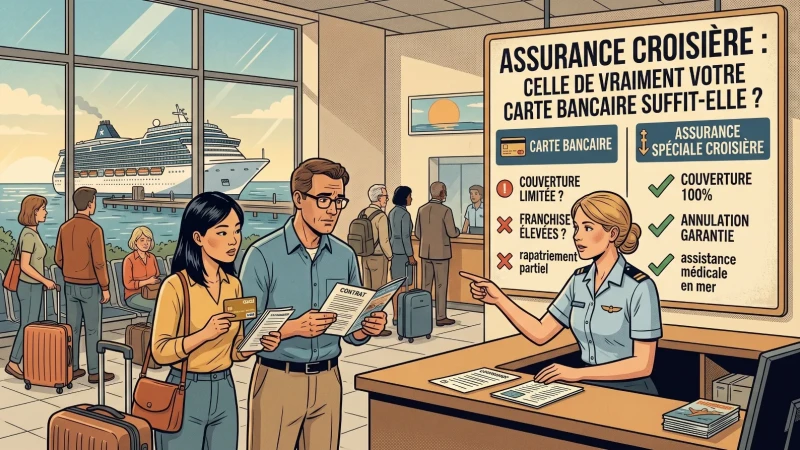
"No need for insurance, I've got my Gold card!" 💳 It's THE line you hear when people book a cruise. And sometimes it is true. But often it is a risky bet.
Because a cruise is not a hotel stay: you are out at sea, far from any hospital, with a medical centre where every consultation is charged, and a ship that will not wait for you if you are late back from a port of call. And since 2026, with the Strait of Hormuz crisis, many cruisers have discovered another nasty surprise: the "war" clause.
So, is your bank card enough? We take stock, no filter. 🎯
Because a cruise is not a hotel stay: you are out at sea, far from any hospital, with a medical centre where every consultation is charged, and a ship that will not wait for you if you are late back from a port of call. And since 2026, with the Strait of Hormuz crisis, many cruisers have discovered another nasty surprise: the "war" clause.
So, is your bank card enough? We take stock, no filter. 🎯
⚠️ The risks specific to cruising
- ❌ Cancelling before departure: illness, accident, death of a loved one, redundancy… A cruise is often expensive and paid for well in advance
- 🏥 Being treated on board: the ship's medical centre charges a fee, and the bill goes on your onboard account
- 🚁 Being evacuated: by helicopter or by boat to the nearest hospital, then repatriated. This is the most expensive risk
- ⏰ Missing the ship: a delayed flight before embarkation, or getting back too late from a shore excursion. The ship leaves without you, and you have to catch up with it at the next port of call (reread our article on the "All aboard" time)
- 🔙 Cutting the cruise short: going home urgently because of a family or medical problem
- 🧳 Losing your luggage: during the flight or at the port
- 🌍 Geopolitical events: conflict, a port closure, an itinerary turned upside down
💰 How much does medical care at sea cost?
Rates vary between cruise lines, but here are some ballpark figures from the trade press and passenger accounts:
- 🩺 Consultation at the medical centre: often around 100 to 150 dollars during opening hours, more at night or in your cabin
- 💊 Tests and medication: a bill can quickly reach several hundred, even several thousand euros (one night under observation was billed at around 2,500 pounds to a British passenger)
- 🚁 Medical evacuation: in the region of 20,000 dollars from the Caribbean to the United States, and sometimes more than 100,000 dollars from remote areas (Alaska, the South Pacific…)
⚠️ On board, your carte Vitale (French health insurance card) is of no use: treatment is charged to your onboard account, to be settled before disembarkation. It is then up to you to claim it back from your insurer… if you have one.
💳 What your bank card (really) covers
📋 The main types of card
- 💳 Standard cards (Visa Classic, standard Mastercard): generally basic assistance (repatriation, limited medical expenses, often around €11,000), and no cancellation insurance
- 💎 Premium cards (Visa Premier, Gold Mastercard): cancellation insurance (often up to €5,000 per year per insured person, sometimes more depending on the bank), medical expenses abroad (up to €155,000 for some Visa Premier cards, considerably less for other cards), repatriation, luggage
- 👑 Top-tier cards (Visa Infinite, Mastercard World Elite): higher limits, often up to €10,000 a year for cancellation
⚠️ Limits vary enormously from one bank to another, even for a card with the same name. Only your card's insurance terms are authoritative: ask your bank for them or download them from your online banking area.
✅ The conditions to meet
- 💳 Having paid for the cruise with the card (in full or in part depending on the policy: some terms require at least 50% of the price)
- 📅 Travelling for a limited period: assistance often covers only the first 90 days of the trip (watch out on world cruises!)
- 📞 Calling the assistance service before incurring major costs (repatriation, hospitalisation)
🕳️ The gaps in the cover for a cruise
Here is where bank cards show their limits as soon as you put to sea:
- 🚁 Evacuation at sea: according to one comparison site, cards often cap evacuation costs at around €10,000 to €15,000, whereas an evacuation at sea can exceed €50,000. And repatriation from a ship is not always explicitly provided for
- 🏥 Medical expense limits: €11,000 is quickly used up by a hospital stay abroad, and derisory in the United States or the Caribbean
- ⏰ Missing the ship: cards generally provide no cover at all for the cost of rejoining the ship at the next port of call (flight, hotel, transfers)
- 💶 The annual cancellation limit: €5,000 per year per insured person is often enough for a couple in the Mediterranean, but not for a family in a suite in the Caribbean, nor for a world cruise
- 📄 Extras bought separately: drinks package, shore excursions and flights booked separately are not always covered in the same way
🚢 What about the insurance offered by the cruise line?
When you book, the cruise line offers you its own insurance. It is convenient, but read carefully what it includes.
An example from Costa, according to the terms published for bookings up to February 2027:
An example from Costa, according to the terms published for bookings up to February 2027:
- ✅ An "Early Booking" option with cancellation for any reason
- ✅ A "Multirisques" (comprehensive) option with cancellation for listed reasons (illness, accident, death, work reasons…)
- ⚠️ But medical expenses capped at €58,200, €2,000 for search and rescue costs at sea, €2,600 for luggage, and €5,200 for curtailment
💡 Our verdict: cancellation is often well covered, but the medical limits remain below what specialists recommend (at least €100,000 for the Mediterranean, more for long-haul destinations).
🛡️ Specialist travel insurance: who is it for?
Specialist insurers offer travel policies, some of them specifically for "cruises", with higher limits.
💶 How much does it cost?
💶 How much does it cost?
- 🧑 Around €55 to €80 for a 35-year-old, 15 days in Europe
- 🧓 Around €85 to €150 for a 60-year-old in the Caribbean or worldwide
- 🎯 "Any reason" cancellation costs more: often 4 to 10% of the price of the trip, with a partial refund
(Ballpark figures from comparison sites in 2026: always get several quotes.)
✅ What to check in the policy
- 🏥 Medical expenses of at least €100,000 (much more for North America)
- 🚁 Cover for search, rescue and evacuation costs at sea, with a proper limit
- ✈️ Repatriation from a ship mentioned explicitly
- ⏰ "Missed departure" or "missed port" cover, if the policy offers it
- 🔙 Curtailment (refund of unused days)
- 📅 The maximum length of trip covered
- 🩺 The conditions for pre-existing medical conditions
🌍 Conflicts, wars, closed ports: what is covered (or not)
This is the big lesson of 2026. Many travellers discovered, during the Hormuz crisis, that their insurance did not cover acts of war.
❌ The "war" exclusion
❌ The "war" exclusion
- 📜 The French Insurance Code (Code des assurances) in principle excludes losses caused by war, unless otherwise stated, and almost all consumer policies (bank cards included) exclude war, whether civil or foreign
- 📅 The date you take out the policy is decisive: an event already known when you take out cover is not covered. Taking out insurance after a conflict has started does not protect you against that conflict
- 🗺️ The advice of the French Ministry of Foreign Affairs matters: some policies refund a cancellation if the destination becomes "formally advised against". Check its "Conseils aux voyageurs" travel advice section before booking… and before cancelling
- 🛡️ Specialist policies exist for high-risk areas, but they are expensive and aimed mainly at business travel
✅ The good news: your rights do not depend on insurance alone
If it is the cruise line that cancels your cruise because of a conflict, you get a full refund under the Code du tourisme (French Tourism Code), with or without insurance. It is all explained in our guide My cruise has been cancelled: refund, credit note, what should I do? Insurance is mainly useful for everything around it: flights and hotels booked separately, costs incurred on the spot, repatriation.
💡 And to find out what happened to the passengers stranded in the Gulf in spring 2026, read our account Stranded in Dubai.
🎯 So, which protection for your profile?
✅ Your premium card may be enough if:
- 🌊 You are sailing in the Mediterranean or Northern Europe, for one or two weeks
- 💶 The price of the cruise stays below the card's cancellation limit
- 💳 You paid with that card, and checked the medical expense and repatriation limits in the terms
- 🧑 You are in good health
🛡️ Take out specialist insurance if:
- 🌴 You are going far afield: the Caribbean, North America, Asia, the Pacific
- 🧓 You are a senior, or you have a known health condition
- 👨👩👧 You are travelling as a family and the total exceeds your card's limit
- 🌍 You are taking a long cruise (more than 90 days, a world cruise)
- ✈️ You have booked your flights separately and are worried about missing embarkation
- 🃏 You only have a standard card
✅ The checklist before you go
- 📄 Get hold of your card's insurance terms and read the limits and exclusions
- 💳 Pay for the cruise with the right card
- 🧮 Check that the total price stays below the cancellation limit
- 🏥 Check the medical expenses, evacuation and repatriation from a ship cover
- 🌍 Read the "war" or "conflict" clause, and consult the Conseils aux voyageurs travel advice
- 📱 Note down the assistance phone number and your policy number (offline!)
- 🔔 Register with Ariane, the French Ministry of Foreign Affairs service
- 🧾 On board, keep all your medical invoices so you can claim them back
💬 In a nutshell
Your premium bank card is a good starting point for a short cruise in Europe. But it has limits that the sea makes very real: medical evacuation, treatment on board, missing the ship, annual limits, and the ever-present war clause.
For a long-haul destination, a family, a senior or a long cruise, specialist insurance at under €150 is often the best-value purchase of your holiday… especially if you never need it. 😉⛵
For a long-haul destination, a family, a senior or a long cruise, specialist insurance at under €150 is often the best-value purchase of your holiday… especially if you never need it. 😉⛵