

South Korea Cruises
About South Korea
Nicknamed the "Land of the Morning Calm", South Korea combines Confucian tradition with high-tech hypermodernity. On calls during Asian cruises, often combined with Japan, it will fascinate you with Seoul, the capital of K-pop, its serene Buddhist temples and the Demilitarised Zone (DMZ).
- Ships call at Incheon (for Seoul), Busan and Jeju, mainly from April to October.
Seoul
Seoul, a bustling capital of nearly 10 million people (around 25 million in the wider metropolitan area, half the country's population), nestles among mountains and blends Joseon-dynasty palaces with futuristic skyscrapers:
- Gyeongbokgung Palace, the main palace of the Joseon dynasty, founded in 1395 and largely rebuilt after the destruction of the Japanese occupation.
- The changing of the guard, colourful and true to tradition.
- The National Folk Museum, within the palace grounds.
- Bukchon Hanok Village, which preserves some 900 hanok, traditional houses with curved tiled roofs.
- The 236 m N Seoul Tower, perched on Mount Namsan, with its panoramic terrace covered in love locks.
- The ultra-modern Gangnam district, south of the Han River, made famous by PSY's "Gangnam Style", with its luxury boutiques, the huge underground COEX Mall and its trendy clubs.
- Changdeokgung Palace, a UNESCO World Heritage Site, and its Secret Garden, Huwon, where nature and architecture live in harmony.
- The Myeong-dong district, a mecca for Korean cosmetics (K-beauty) and street food.
- The Insadong district, known for its crafts and traditional tea houses.
DMZ
The DMZ (Demilitarised Zone), which has separated South Korea from communist North Korea since the 1953 armistice, roughly along the 38th parallel, can be visited on military-escorted tours:
- The infiltration tunnels dug by North Korea.
- Dora Observatory, from which you can glimpse the North.
- JSA Panmunjeom (Joint Security Area), with its blue huts where soldiers from North and South face each other just a few metres apart: the tension remains palpable, a relic of the Cold War.
Busan
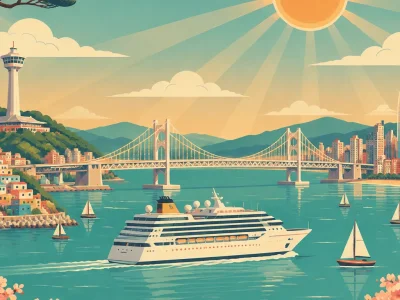
Busan, the country's second city and great southern port, has more than 3 million inhabitants and offers:
- The urban beaches of Haeundae and Gwangalli.
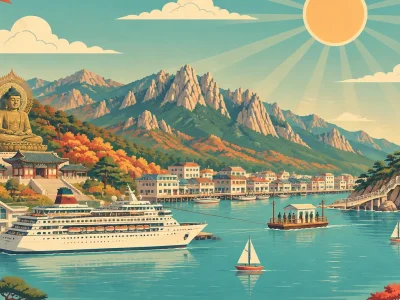
- The Buddhist temple of Haedong Yonggungsa, clinging to the rocks facing the ocean.
- The gigantic Jagalchi fish market.
- Gamcheon Culture Village, whose colourful houses cling to the hillside, nicknamed the "Korean Santorini".
Jeju
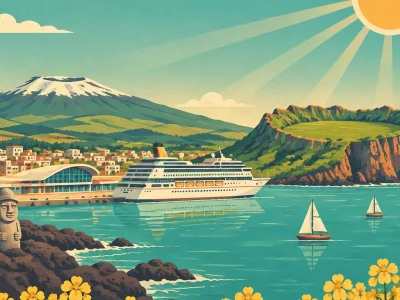
The volcanic, subtropical island of Jeju, a self-governing province nicknamed "Korea's Hawaii", will win you over with:
- Mount Hallasan, a volcano rising to almost 1,950 m, the highest point in the country.
- Its beaches of sand and black volcanic rock.
- The haenyeo, women divers, often elderly, who gather seafood by free-diving without air tanks, and whose culture is inscribed on UNESCO's intangible heritage list.
Korean cuisine
Korean cuisine, often spicy, will introduce you to:
- Kimchi, fermented spicy cabbage served with every meal.
- Bulgogi, marinated and grilled beef.
- Bibimbap, a bowl of rice topped with vegetables, an egg and gochujang (chilli paste), mixed together before eating.
- Korean BBQ, meat you grill yourself at the table.
- Tteokbokki, rice cakes in a spicy sauce.
- Soju, the national spirit, traditionally distilled from rice and usually between 16% and 20% ABV.
South Korea cruise regions
Regions that include South Korea:

Ports of call in South Korea
Weather and climate in South Korea
| Region | Winter (December to February) | Spring (March to May) | Summer (June to August) | Autumn (September to November) |
|---|---|---|---|---|
| South Korea - West coast (e.g. Incheon) |
-5°C / 5°C
15-25 km/h
83%
17%
07:30
17:30 |
8°C / 18°C
10-20 km/h
80%
20%
06:15
18:45 |
22°C / 32°C
10-20 km/h
82%
18%
05:15
19:30 |
10°C / 22°C
10-20 km/h
84%
16%
06:15
17:45 |
| South Korea - South coast (e.g. Busan) |
0°C / 10°C
10-20 km/h
87%
13%
07:15
17:30 |
10°C / 20°C
10-20 km/h
84%
16%
06:00
18:30 |
23°C / 33°C
10-20 km/h
88%
12%
05:15
19:15 |
12°C / 24°C
10-20 km/h
90%
10%
06:00
17:45 |